

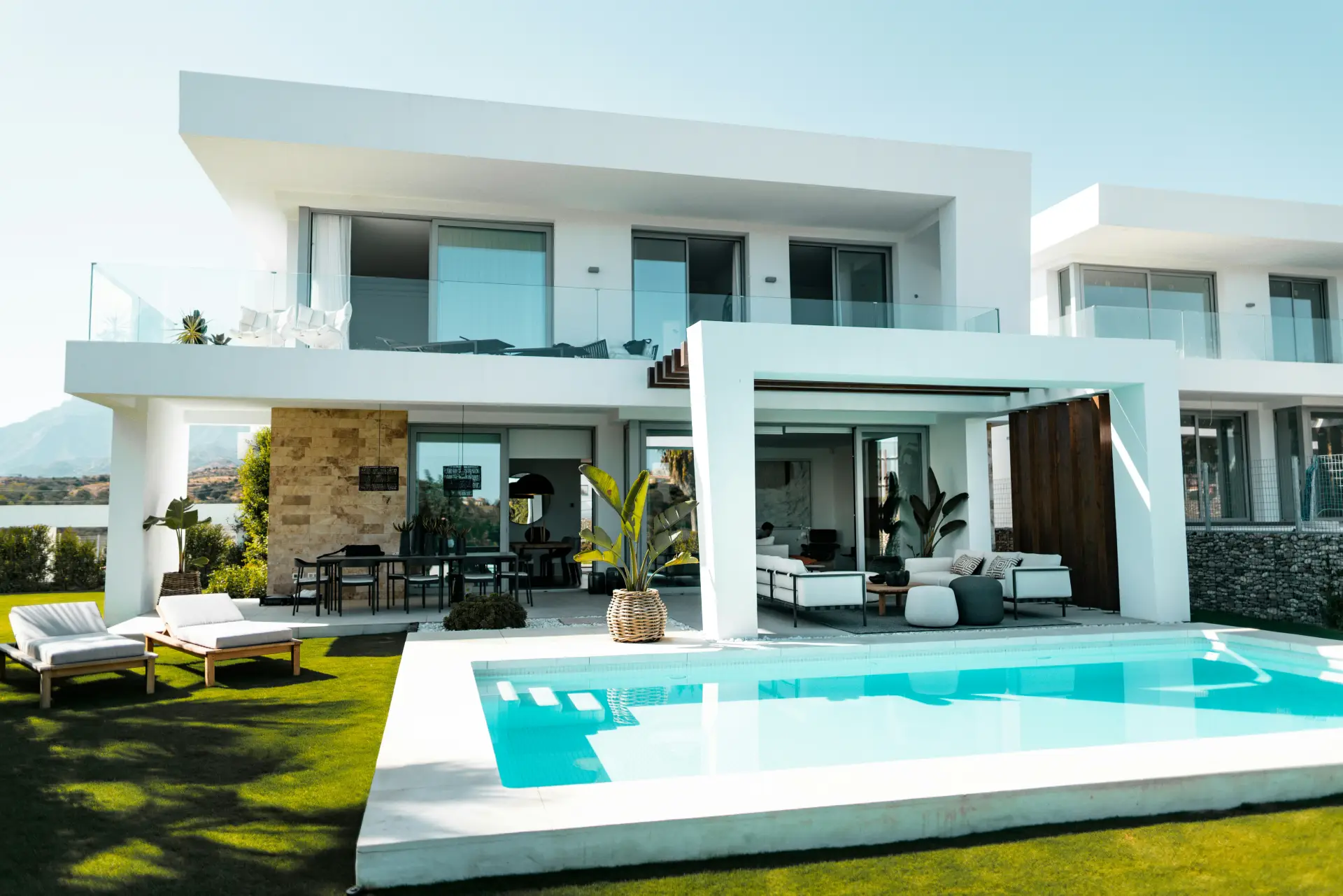
Bali closed out 2025 with 6.95 million tourists, a 9.7% increase over the previous year. Meanwhile, its well-managed villas are benefiting from this, offering gross returns of between 13% and 15%.
These returns are not pure luck, they stem from structural factors: an economy growing above 5% while the Eurozone barely scrapes past 1%, tourism that’s stopped depending on the season, and prices that haven’t yet priced in what’s coming over the next five years. The upside is real.
So are the traps: property titles that don’t survive proper due diligence, illegal nominee agreements dressed up as a solution, and tax schemes that look like they eliminate taxes on paper while leaving the investor exposed to two tax authorities at once in practice.
This guide gives you the full picture: why Bali is a serious market in 2026, which areas offer the best return-to-risk ratio (including Uluwatu and the emerging alternative of Lombok), how the legal framework works for foreigners, what a PT PMA is and when you need one and the buying process step by step.
Why Bali Is a Good Market to Invest In 2026
The economy behind the market
Indonesia is the fourth most populous nation in the world and Southeast Asia’s largest economy. It grew 5.1% in 2024 and slowed to 4.7% in 2025, against 0.8% for the Eurozone. That gap explains why international capital keeps flowing into the country while it flows out of Europe.
Inflation at 2.8%, unemployment at 5.2%, and reserves above 150 billion dollars round out the picture of a mature economy. Real estate transactions in Bali, on top of that, are done in US dollars: real currency diversification against the euro.
There’s one factor few analysts look at: Jakarta. It isn’t a holiday destination, but it accounts for 70% of the country’s foreign business investment and is Southeast Asia’s largest premium office market. Its upper middle class is one of the drivers of the domestic tourism that keeps Bali’s occupancy up when international travel cools off. Indonesia is even building a new capital, Nusantara: proof that behind Bali there’s an economy with real institutions, not just beaches.
Structural tourism, not a passing trend
Bali has spent more than two decades as Southeast Asia’s top tourist destination. In 2025 it welcomed 6.95 million tourists, up 9.7% on the year before. The number that matters most to investors isn’t the volume but the spending profile: 1,420 dollars on average per stay, with an average length of 9.3 nights. This isn’t backpacker tourism: it’s a customer with real willingness to pay for premium accommodation.
Average occupancy for professionally managed villas in prime areas runs above 75% a year, with peaks of 90-95% in high season. In Canggu, demand is so steady that seasonality has practically disappeared.
Key takeaways
- Indonesia grew 5.1% in 2024, against 0.8% for the Eurozone.
- Bali closed 2025 with 6.95 million tourists, up 9.7% on the year before.
- Average spend per tourist: 1,420 USD, with stays of 9.3 nights.
- Average occupancy for managed villas: 75%+ a year, with peaks of 90-95%.
- Price growth in expanding areas has run at 15-25% year on year in 2024-2025.
The Best Areas to Invest in Bali
Bali covers 5,780 km² across eight administrative regencies. Buying in Canggu isn’t the same as buying in Nusa Dua, and Ubud isn’t the same as Uluwatu: each area has its own demand dynamics, buyer profile, and stage in the property cycle.
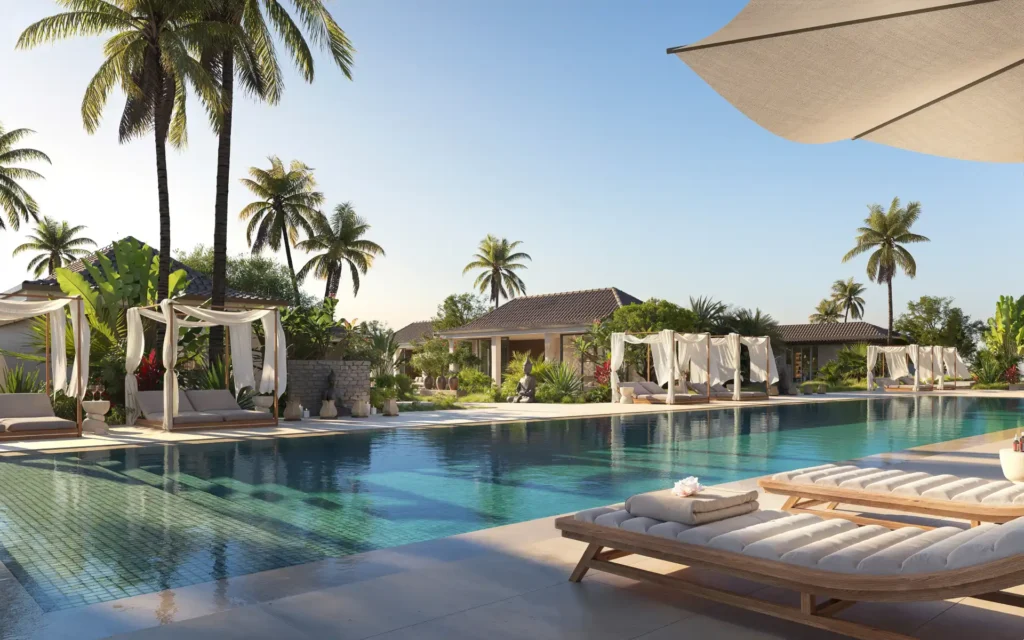
Canggu: the hottest market on the island
Over eight years, Canggu went from surf village to hub of premium millennial tourism: coworking spaces, yoga studios, world-class dining. It’s the area with the highest density of quality supply and also the most liquid when it comes to reselling.
Gross returns run between 12% and 15%, with average occupancy above 80%. Prices rose 20-22% year on year over recent years, and it remains the most natural entry point for anyone wanting exposure to the highest-yielding segment.
Uluwatu and the Bukit Peninsula: the five-year play
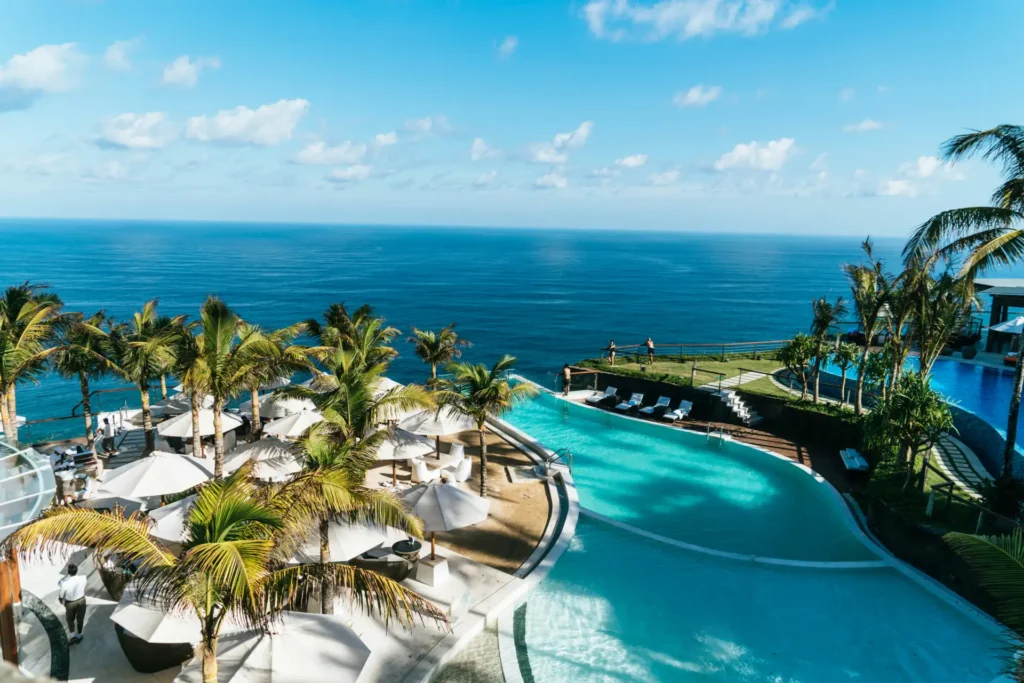
In the south of the island, where the cliffs drop into the Indian Ocean, sits what is probably the market with the highest revaluation potential across all of Bali through 2031. Uluwatu, Bingin, Balangan, Padang Padang: a style of boutique resort architecture with no equivalent elsewhere on the island, with occupancy of 78% in high season and some of the highest nightly rates in Asia.
Prices in Uluwatu are still 20% to 35% below Canggu or Seminyak for comparable product. Gross returns of 10% to 14%, with price growth of 18-25% year on year, and institutional investment already arriving in the form of international boutique hotels.
Seminyak and Kerobokan: the mature market
Seminyak is Bali’s established side: landmark boutique hotels, sophisticated nightlife, and the most complete service infrastructure on the island. Somewhat more conservative returns (9-12%) but with lower volatility and less seasonality: the logical choice for anyone who prioritizes stability over upside.
Ubud: culture, longer stays, and less competition
Bali’s spiritual heart draws a different kind of tourist: more European, older, staying 5 to 7 nights compared with 3 to 4 on the coast. Returns of 8-12%, with more seasonality (a dip in September-October) but some of the highest nightly rates on the island.
Nusa Dua and Jimbaran: the international luxury hub
This is where chain luxury hospitality is concentrated: Hilton, Ritz-Carlton, St. Regis. Maximum legal and operational security, but higher entry tickets (from 350,000 USD) and revaluation upside that’s largely already priced in. Returns of 7-10%.
Lombok: the emerging alternative worth knowing
Lombok isn’t Bali, and that’s worth stating clearly from the outset. But as a complementary strategy to a position already built in Bali, it deserves serious consideration. It’s 35 minutes away by plane or two hours by fast boat, shares exactly the same legal framework (same land law, same titles, same PT PMA structure), and has prices 30% to 50% below Bali’s for comparable areas. In 2025 it welcomed close to 1.8 million international tourists, up 24% on the year before, driven by the premium surf scene of the Gili Islands and trekking on Mount Rinjani.
The areas of most interest are Kuta Lombok (world-class surf, returns of 10-14% and the island’s highest revaluation potential at 20-28% year on year), Gili Trawangan (returns of 13-17%, though supply is very limited) and Senggigi (the most established corridor, 7-10% returns and lower risk).
| Area | Gross yield | Price growth 24-25 | 2BR villa ticket |
|---|---|---|---|
| Canggu | 12% – 15% | ~20-22% | 200,000 – 350,000 USD |
| Uluwatu / Bukit | 10% – 14% | ~18-25% | 150,000 – 300,000 USD |
| Seminyak / Kerobokan | 9% – 12% | ~12-15% | 250,000 – 450,000 USD |
| Ubud | 8% – 12% | ~10-14% | 180,000 – 320,000 USD |
| Nusa Dua / Jimbaran | 7% – 10% | ~8-11% | 350,000 – 700,000+ USD |
| Kuta Lombok | 10% – 14% | ~20-28% | 100,000 – 200,000 USD |
| Gili Trawangan (Lombok) | 13% – 17% | ~15-20% | 150,000 – 280,000 USD |
Is the Bali the right investment for you?
It depends on your situation and goals.
We review your case and confirm whether it makes sense for you, what steps you’d need to take, and your best investment alternatives.
Legal framework for foreigners
This is where most guides oversimplify, or skip what matters most entirely. Indonesia doesn’t allow foreigners to own land outright (Freehold). That’s the starting point. It doesn’t mean you can’t invest with real legal security. It means you have to structure it properly.
The system is governed by the 1960 Agrarian Law (UUPA), which sets out several types of land right, not all of them open to foreigners:
- Hak Milik (full ownership): for Indonesian citizens only. No foreigner can hold it under any circumstances, whether as an individual or through a company.
- Hak Guna Bangunan (HGB): a building right lasting 30 years, renewable up to 80 years in total. Available to Indonesian legal entities, including PT PMAs: the main route for anyone operating through a company.
- Hak Pakai (right of use): 30 years plus a 20-year renewal, available only to foreigners with residency (KITAS/KITAP). Tied to that permit: if it lapses without renewal, the title is at risk. Not practical for anyone without residency.
- Hak Sewa / Leasehold: the most common route for individual investors. It isn’t a title over the land itself, but a notarized lease agreement of 25-30 years with a renewal option, giving an effective term of 50 to 60 years. Properly drafted, it’s a route with sufficient legal security.
- Strata Title (HMSRS): horizontal ownership for apartments. Technically open to foreigners, though in practice most apartment deals go through Leasehold or a PT PMA.
⚠️ What you should never do: a nominee agreement (putting land in the name of a trusted Indonesian) is explicitly illegal. It has no legal standing and gives you no way to make a claim if the named holder acts in their own interest. It can mean losing all of your capital.
The PT PMA
A PT PMA (a company with foreign capital) is the standard vehicle for operating in Bali properly. It has its own legal personality, can hold HGB titles, open local bank accounts, and hire staff, with real separation between the Indonesian asset and your personal wealth.
With experienced local advice, it can be up and running in 4 to 8 weeks. The minimum authorized capital is 10 billion rupiah (roughly 580,000 USD), but the initial payment can be as low as around 145,000 USD, with the rest contributed as the investment progresses. Setup costs run around 2,500-5,000 USD, and annual upkeep between 1,500 and 3,000 USD.
The law requires a Director and a Komisaris, often resident in Indonesia. A “local nominee director” (a professional who lends their name under contract, with limited powers) is a legal and common practice, distinct from a land nominee: here the authority is contractually controlled; there, ownership is unrestricted.
For deals from 200,000-250,000 dollars upward, the cost of a PT PMA is comfortably justified by the legal security and the ability to scale to more than one asset.
Taxation in Indonesia
Taxes on the purchase and sale
| Tax | Rate / Base | Who pays |
|---|---|---|
| BPHTB | 5% of price or tax value (whichever is higher) | Buyer |
| PPh Final | 2.5% of gross sale price | Seller (withheld) |
| PPN (VAT) | 11% when the seller is a developer/company | Buyer (included in price) |
| PBB (annual) | 0.1-0.3% of tax value | Owner |
On rental income, the difference between investing as an individual and doing so through a PT PMA is significant. As an individual, you pay a flat 20% on gross income, with no deductions. Through a PT PMA, the company pays 22% on net income, deducting management, maintenance and commissions (30-45% of gross income). The result: an effective rate of 8-14% with a PT PMA, against a flat 20% without one.
Buying process
- Due diligence. Verify the title (Hak Milik, HGB, Hak Pakai) with the BPN, confirm there are no liens or disputes, and check the IMB building permit and zoning (RTRW). This isn’t optional.
- Letter of intent and deposit. A PPJB with a deposit of 10-20%. For off-plan projects, it needs deposit protection (escrow, trust) and penalties for delays.
- Final contract before a PPAT. The notary who specializes in land transactions. If you can’t be present, an apostilled power of attorney works.
- Taxes and registration. BPHTB (5%, buyer) and PPh Final (2.5%, seller), paid before registration with the BPN, which takes 2 to 6 months.
Types of asset
- Villa with local management: the flagship product. The investor typically receives 70-80% of gross income. Returns of 10-15%.
- Apartment with delegated management: a lower entry ticket (from 120,000-150,000 USD), more conservative returns (8-12%), and almost no operational involvement.
- International condo-hotel: operational ease in exchange for a smaller share of income (40-55%) and less control over pricing.
- Ground-up development: the highest potential return (40-70% over 24-36 months), but also the highest risk: contractor, timelines, and market conditions at the point of sale.
Bali against other markets
Bali isn’t the only market worth investing in. But on the combination of real returns, accessibility, and growth potential, it’s at the top of the ranking in 2026:
| Market | Gross yield | Entry from | Taxation |
|---|---|---|---|
| Bali | 10% – 15% | ~€120,000 | Favorable (tax treaty + PT PMA) |
| Punta Cana | 7% – 11% | ~€140,000 | Favorable (CONFOTUR) |
| Phuket | 8% – 12% | ~€70,000 | Good |
| Dubai | 7% – 12% | ~€100,000 | No taxes |
| Miami | 3% – 5% | ~€300,000 | High deductibility |
Bali’s advantage is the combination of mature tourism with prices that still haven’t priced in the growth ahead. Phuket offers similar returns but a more restrictive legal framework (in Thailand, foreigners have no direct title to land at all). Dominican Republic offers stronger legal security through CONFOTUR, though with somewhat more moderate returns. Dubai has zero taxation, but much of its price growth has already happened.
If you’d like to compare other international markets with a good balance of returns and taxation alongside Bali, we have something that might interest you: our free International Real Estate Investment Guide, covering countries where you can find returns of up to 15% and markets with 0% taxes.
Preguntas Frecuentes
They can’t hold full ownership (Hak Milik), which is reserved for Indonesian citizens. They can access real legal security through Leasehold (a long-term lease with an effective term of 50-60 years) or, for investors looking to operate on an ongoing basis, through a PT PMA with access to an HGB title of up to 80 years.
Gross returns range from 7% to 15% depending on the area: from 7-10% in Nusa Dua to 12-15% in Canggu. With a well-planned tax structure (PT PMA), the real net return can top 8%, against roughly 7% investing as an individual without one.
They’re not mutually exclusive. Bali offers a more mature market, better liquidity, and lower execution risk. Lombok shares the same legal framework but with prices 30-50% lower and higher revaluation potential (up to 20-28% year on year in Kuta Lombok). For anyone who already has a position in Bali, Lombok is a complementary, higher-upside bet; as a first or only investment, the calculation is different.
Not always. For a one-off, smaller-volume investment, a well-drafted, notarized Leasehold can be enough. A PT PMA makes sense from tickets of 200,000-250,000 dollars upward, or when there’s an intention to operate several assets, thanks to expense deductibility, asset separation, and access to HGB titles.