


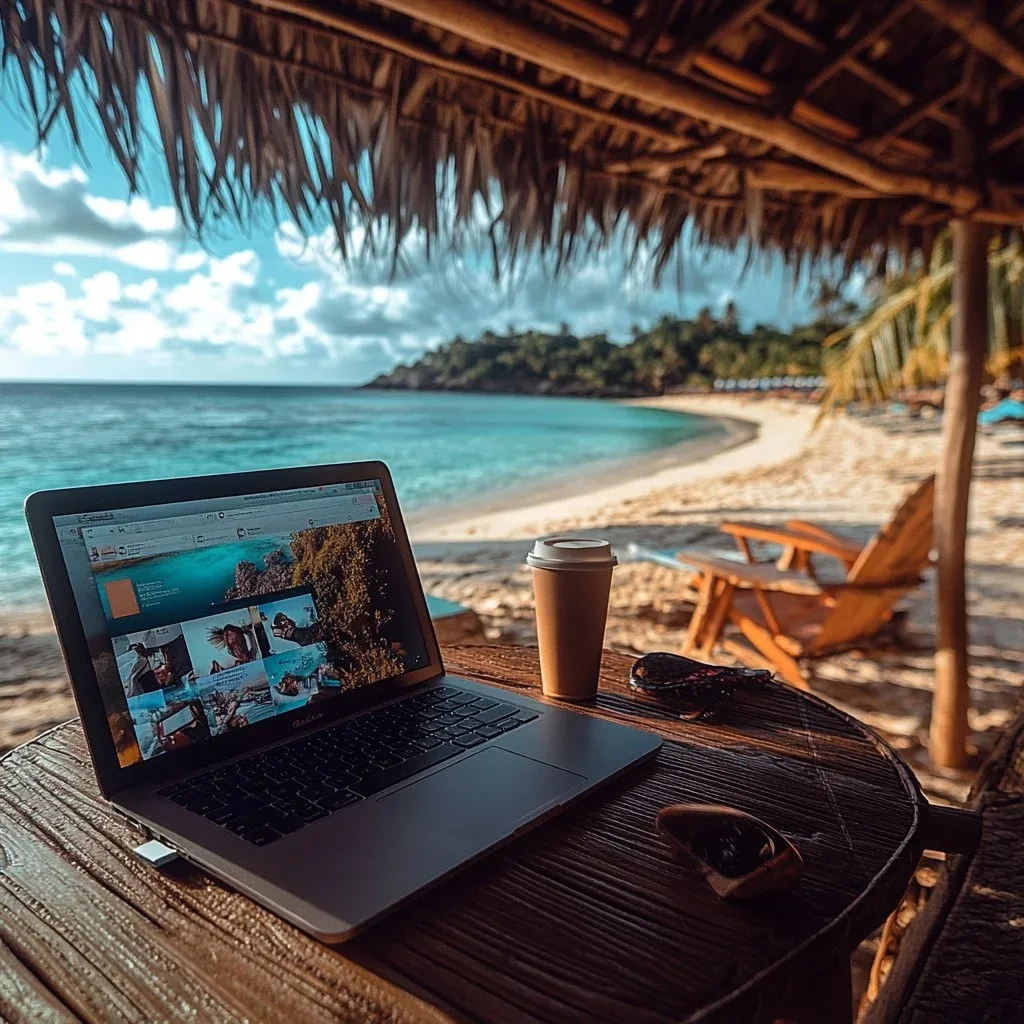




Tax nomads are people who reclaim their tax freedom by strategically relocating their residency, businesses, and assets to the countries that best support their personal and financial goals.
They know that their life, wealth, and future should never depend on a single country.
If you’ve made it this far, you’ve probably already realized that Tax Nomads is not just a tax advisory firm.
And you’re right.
Tax Nomads is the result of something much deeper: a historic shift that is redefining the relationship between individuals and the State.
To truly understand what a tax nomad is, we need to go back to the origin of taxes, modern states, and the logic that shaped today’s system.
Because only when you understand how the system was built, do you see why you now can (and should) reclaim your tax freedom.
For most of our history, humans were nomadic.
We constantly moved in search of food, hunting, and safer territories.
Mobility was our most effective survival strategy in a constantly changing environment.
Everything changed with agriculture and livestock.
When cultivating land and domesticating animals became more efficient for producing food, the strategy shifted from moving to settling down.
But that decision came at a cost: our freedom.
For centuries, the system seemed immovable: you lived where you worked, and paid taxes where you lived.
There was no room to maneuver.
Then something happened that no state could have anticipated.
By the late 20th century, and even more so in the 21st, value began to go borderless. For the first time, a person could earn income, run a business, and invest internationally without depending physically on a single territory.
The internet wasn’t just a communication tool. It was the engine of economic mobility.
Remote work became the norm, banking went digital, transportation got cheaper, and countries began competing fiercely to attract capital and talent.
The result? Taking advantage of competition between countries to pay less tax stopped being a privilege for the few. Now it’s a real option for millions.
Those who generate income from anywhere or have significant wealth.
Now that you understand the scale of this movement, you’ll see why Tax Nomads wasn’t born in an office.
Co-Founder & Head of International Tax
Leads our headquarters from Dubai, after advising international clients at KPMG Luxembourg and Amsterdam.
KIKE GUILLÉN
Founder & CEO
Currently travels across the countries we operate in, following his experience living and running businesses in hubs like Dubai, Cyprus, Hong Kong and Estonia.
BELTRÁN DE CASTRO
Head of International Investments
Tax resident in Paraguay, where he combines flexible residency with regular travel to the countries where we invest.
Tell us about your situation and your goals.
We’ll review your case. If it’s a good fit, we’ll show you where to start.
When a population settles and produces consistently, that production can be accumulated. And if something can be accumulated, it can also be taken away.
That’s how a pattern began that repeated itself across most regions of the world.
Wherever there were settled populations with concentrated resources, groups emerged that imposed their authority by force and demanded tribute on that production.
That’s where taxes were born.
Over time, this logic became institutionalized. Extraction stopped being occasional and became permanent.
Kingdoms centralized power, created registries, established taxes, and defined borders. Individuals stopped moving freely and became identified and subject to an authority.
The Industrial Revolution refined this model. Work became concentrated in cities, making it easier to control and tax large populations.
By the late 19th century, modern passports, administered borders, and formal national identity emerged.
That’s how modern states were born.
And with them, the map we know today: more than 195 states, each with the power to legislate, collect taxes, and decide the rules within their own borders.
But only within them.
A state can legislate, regulate, and tax as it pleases within its borders…
But no state can control all the others.
What we colloquially call “the system” is, in reality, a system of systems: countries with different laws, incentives, and tax strategies, competing permanently.
And from that competition comes your power to choose: where you live, where you invest, where you protect your wealth, under whose rules you play.
For decades, using multiple countries to optimize structure, taxation, and asset protection was a luxury reserved for the ultra-wealthy and corporations. Today it’s within reach of those who understand the game board.
It’s not about hiding, but about strategically choosing where to live, where to operate, and where to invest.
Today, mobility is once again an advantage.
And from that advantage, the tax nomad is born.